Potential, ignited: Cathedral High School Swim Team Sends Three Student’s to OFSAA thanks to YMCA Partnership

For years, Cathedral High School’s swim team faced an uphill battle before they ever stepped onto the starting block. Without consistent access to pool time and competing against schools with pools embedded into their daily schedules, swimmers worked hard, but often hit a ceiling. Talent and effort were there. Opportunity was not.
That changed when a partnership with the YMCA, made possible through social prescription, opened the doors not only to a pool, but to a community that would fundamentally reshape the team’s future.
“It honestly just kind of fell into our lap, amazingly,” said Lori, Cathedral’s swim coach. What began as a search for additional practice space turned into something far greater. Through the YMCA partnership, the swim team was granted regular pool time and individual YMCA memberships for each swimmer.
“We were just looking for more time in the pool,” Lori explained. “The memberships went far beyond that.”
This collaboration was funded by the Canadian Red Cross Financially Assisted Social Prescribing (FASP) project. FASP is an innovative approach to fund initiatives that increase health equity and informed care and services by bringing health, community, and social sectors together. Health care providers and community organizations refer clients to the YMCA for support, such as social connection, recreation, and wellness programs to address the root causes of health or unmet needs. This funding enables access for students to have pool time and access to YMCA services that ignite their potential.
Before the partnership, limited access meant swimmers practiced sporadically, often with weeks between sessions. Progress plateaued. Confidence stalled. The YMCA changed that rhythm entirely.
“Being able to have them in the pool two days a week, and then have them be able to use their own time without having to spend more money, has been huge,” Lori said. “Their progress in the pool has been leaps and bounds from previous years.”
With YMCA memberships, swimmers weren’t confined to team practices. They could come early in the morning, right after school, on weekends—whenever fit their lives. Training became something they owned.
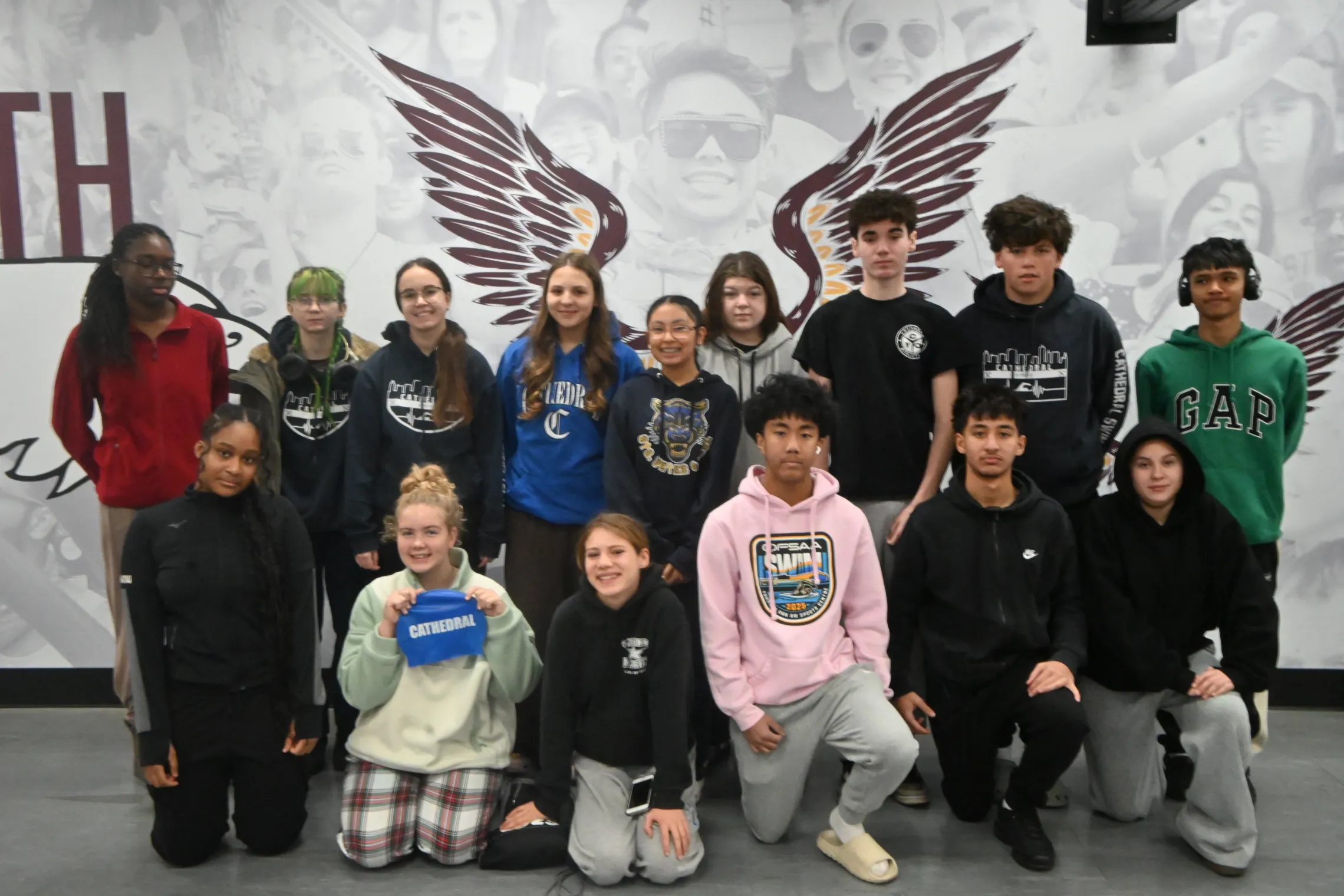
For Josh (wearing the pink hoodie above), a Grade 9 swimmer, that ownership made all the difference.
“Last year, I barely wanted to go to practice,” he said. “I didn’t feel like I was getting stronger.” This season was different. “I’ve been using the YMCA pools every morning and I’m actually getting stronger.”
Josh began swimming daily—sometimes twice a day—taking full advantage of early-morning lane swims.
“The Y is one of the main reasons why I got to finals,” he said. “I went to lane swims at 6 a.m. every day. It pushed my discipline. It pushed my muscles.”
The results were immediate and measurable. After placing 33rd the year before, Josh finished 8th, advancing to the OFSAA (Ontario Federation of School Athletic Associations) finals.
“It felt amazing,” he said. “It was such a blessing to be able to go.”
A Place Where They Belong
The impact went far beyond faster times. For Lori, one of the most powerful changes was how the YMCA welcomed every swimmer.
“Our demographic is very all over the place,” she said. “For them to have the opportunity to come to the Y and use the facility—not just the pool, but all of it—they got a sense of community. They were welcomed in.”
At the YMCA, swimmers weren’t treated as outsiders or guests. They felt like they belonged.
“They weren’t expected to have to pay for everything right off the top,” Lori said. “They were able to use everything without question.”
That sense of belonging extended to relationships with staff and lifeguards, many of whom took a personal interest in the swimmers’ development.
“The staff are amazing,” Lori said. “One of the lifeguards has actually taken some of our swimmers under their wing. When they come for lane swims, he’ll say, ‘Try this, fix that.’ It’s extra coaching, it’s what it means to be part of the Y community.”
Those informal moments added up.
“They know the lifeguards by name,” Lori added. “The lifeguards know the swimmers. It’s like a little family community again.”
Josh felt that warmth immediately. “Everyone is super nice,” he said. “I met a lifeguard here who started training me when I would come to practice on my own. He’s really helping me.”
For Mike, an 18-year-old senior swimmer, having consistent access to the YMCA transformed not just his skill, but his motivation.
“My swimming skill definitely skyrocketed,” he said, “as well as my passion for swimming.”
He credits YMCA staff directly. “Staff members and lifeguards really helped me reach my full potential,” Mike shared. “They’re probably one of the main reasons why I was able to compete.”
With more practice time and encouragement, Mike reached a milestone many swimmers only dream about.
“I think everybody dreams of going to OFSAA,” he said. “Having the pool available for lots of practices during the week really helped me achieve that goal.”
He was clear about the bigger picture too: “I don’t think our team would have been as successful if we didn’t have access to a pool like this.”
Mike has since been accepted to Brock University where he hopes to continue his swimming journey.
Breaking Through Barriers
The YMCA partnership addressed a fundamental inequity. Some swimmers couldn’t afford city pool fees. Others couldn’t make limited lane-swim times. Social prescription removed those barriers.
“The Y has so many hours,” Lori said. “They could come in the morning, after school, evenings—it felt free. It felt less scheduled.”
That freedom allowed swimmers to push themselves physically and mentally. For athletes who had once seen swimming as “just something they do,” the shift was profound.
“Now they’re talking about swimming in college or university,” Lori said. “They’re seeing [beyond] right now. They’re seeing opportunity.”
The results spoke for themselves. That season, multiple Cathedral swimmers qualified and placed at the highest levels in Ontario school swimming.
For Uwa, the YMCA was instrumental in taking that final step forward.
“I would not have been able to succeed without having such a reliable and open space,” Uwa said. “With the YMCA’s extra pool time, I was able to drop a significant amount of time, which led me to become an OFSAA participant.”
Uwa placed sixth at OFSSA.
Beyond the stopwatch, she emphasized the people. “The staff were so eager and kind-hearted in helping me improve and reach my full potential.”
At its core, this partnership shows what happens when access, trust, and care intersect.
“It’s fun now,” Lori said simply. “To see the growth I knew was in them.”
Through the YMCA and social prescription, Cathedral’s swim team didn’t just find a pool. They found consistency. They found confidence. They found a place where effort was supported, potential was nurtured, and young people could see themselves—perhaps for the first time—as athletes, leaders, and members of a broader community.
When the season ended, the swimmers didn’t stop showing up.
“They’re still coming,” Lori said. “They’re still swimming. They’re already talking about next year.”
And that may just be the clearest measure of success.